Last updated: October 2026. Human written and fact checked against each named source.
A record 2.12 million adults in Ireland now play sport every week, yet only around two in five meet the national physical activity guidelines, and the average adult sits for more than five hours on a weekday. This page gathers the most current, verifiable physical activity statistics for Ireland in one place, drawn from the CSO’s Labour Force Survey, Sport Ireland’s Irish Sports Monitor, the Department of Health’s Healthy Ireland Survey and the WHO. It is written for journalists, students, sports and health writers, and anyone who needs a sourced Irish figure on exercise, sport participation or inactivity.
Key Physical Activity Statistics for Ireland at a Glance
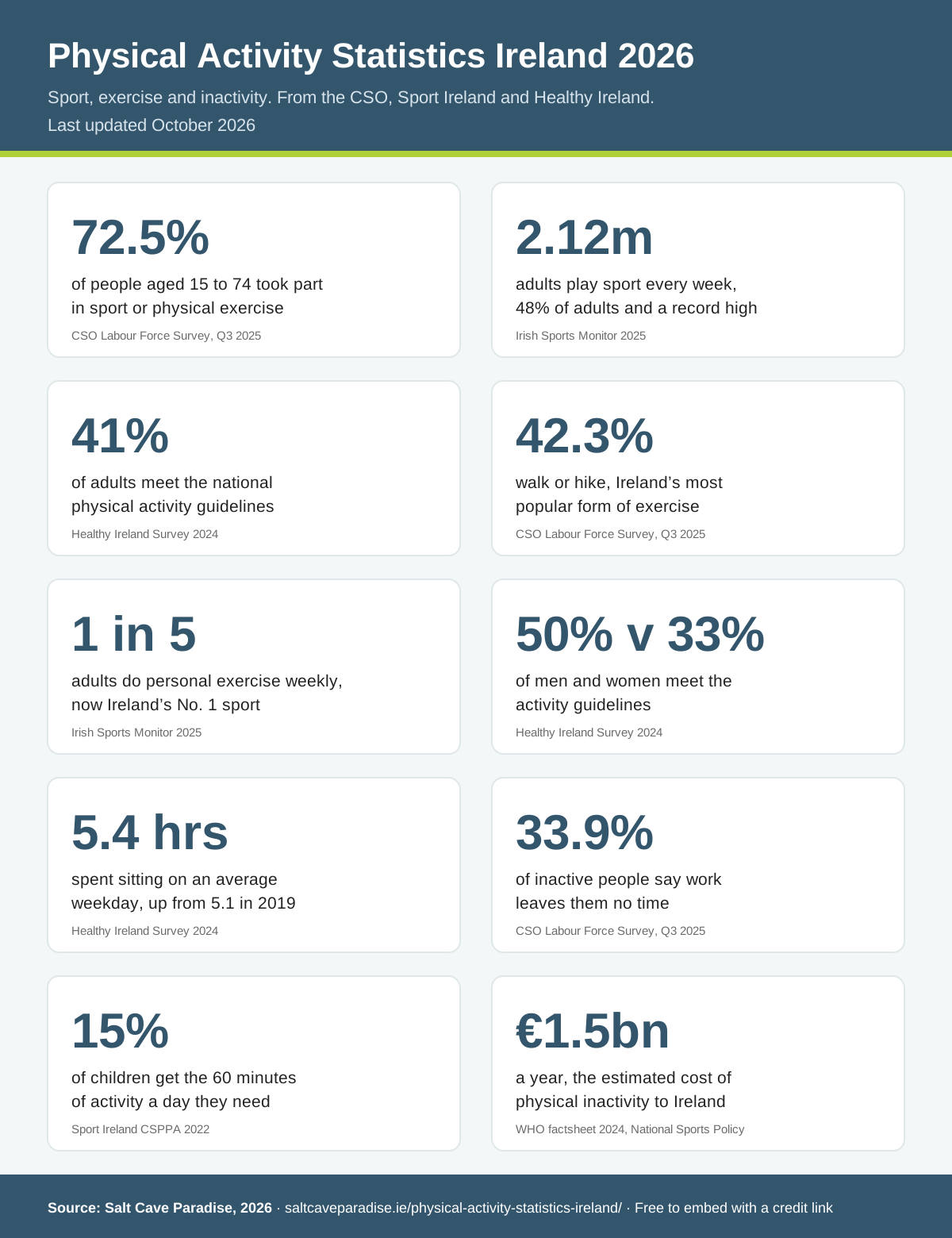
- 72.5% of people aged 15 to 74, or 2,966,000 people, took part in at least one sport or physical exercise in the CSO’s most recent measure. Source: CSO Labour Force Survey, Sports and Physical Exercise Q3 2025, published September 2026
- 48% of adults play sport every week, a record of about 2.12 million people. Source: Sport Ireland, Irish Sports Monitor 2025
- Only 41% of adults meet the national physical activity guidelines, down from 46% in 2019. Source: Healthy Ireland Survey 2024
- Walking and hiking is Ireland’s most popular activity, done by 42.3% of 15 to 74 year olds, ahead of gym-based activities at 22.4%. Source: CSO, September 2026
- Personal exercise is now the most popular sport in Ireland, with 1 in 5 adults doing it weekly. Source: Irish Sports Monitor 2025 Summary Report
- Men are far more likely than women to meet the activity guidelines, at 50% against 33%, a 17-point gap. Source: Healthy Ireland Survey 2024
- Adults sit for an average of 5.4 hours on a weekday, up from 5.1 hours in 2019. Source: Healthy Ireland Survey 2024
- Lack of time because of work is the number one reason people give for not exercising, cited by 33.9% of those who do not. Source: CSO, September 2026
- Only 15% of children meet the guideline of an hour of moderate-to-vigorous activity a day. Source: Sport Ireland, Children’s Sport Participation and Physical Activity Study 2022
- Physical inactivity costs Ireland approximately €1.5 billion a year. Source: WHO Ireland Physical Activity Factsheet 2024, citing the National Sports Policy
Three Ways of Measuring How Active Ireland Is
Ireland has three official measures of physical activity, and they give very different headline numbers. Anyone quoting one should know what it actually counts, because they are not in conflict.
The broadest is the CSO’s, from a module of the Labour Force Survey. It found that 72.5% of people aged 15 to 74 took part in at least one sport or physical exercise, and it counts walking or hiking as exercise. Source: CSO Labour Force Survey, Sports and Physical Exercise Q3 2025, published 24 September 2026. The middle measure is Sport Ireland’s: 48% of adults played sport in the past seven days, a figure that excludes recreational walking. Source: Irish Sports Monitor 2025. The strictest is the Department of Health’s: 41% of adults meet the national guidelines of at least 150 minutes of moderate activity a week, again excluding walking. Source: Healthy Ireland Survey 2024, the most recent wave to measure physical activity.
Read together, they say that most people do something, about half play some sport in a typical week, and well under half do enough to meet the guidelines. Sport Ireland’s own guideline-based measure lands in the same place as the Department of Health’s, with almost two in five adults classed as highly active through sport and recreational walking, a slight fall on 2024. Source: Irish Sports Monitor 2025.
How Many People Play Sport
Sport Ireland’s Irish Sports Monitor interviewed 8,529 adults aged 16 and over through 2025. It found 48% of the adult population participating in sport regularly, about 2.12 million people, the highest number since records began. In percentage terms that is no statistically significant change on 2024: the count keeps rising because the population does. Source: Sport Ireland, Irish Sports Monitor 2025, published May 2026.
Sport is social as well as physical. 47% of adults, about 2.04 million, take part socially through club membership, volunteering or attending events, up from 46% in 2024. Club membership has reached 37% of adults, up from 34% in 2017, while 11% volunteer in sport each week and 19% attend a sporting event weekly. Source: Irish Sports Monitor 2025.
The Most Popular Activities
Ranked by weekly participation, the ten most popular sports in Ireland are personal exercise, swimming, running, cycling, lifting weights, Gaelic games, soccer, dancing, yoga and golf. Personal exercise is the clear leader and still growing, with 1 in 5 adults now doing it every week, a sign of rising demand for flexible, individual activity over fixed team schedules. Sources: Irish Sports Monitor 2025 and its summary report.
The CSO’s broader measure, which includes walking, ranks activities as follows, and shows Dublin leaning further towards the gym, running and cycling than the rest of the country. The table below is compiled from CSO PxStat table QLF66.
| Activity (people aged 15 to 74) | Ireland | Dublin |
|---|---|---|
| Walking or hiking | 42.3% | 41.5% |
| Gym-based activities | 22.4% | 27.8% |
| Swimming | 9.8% | 10.5% |
| Running or athletics | 9.3% | 12.0% |
| Cycling | 6.9% | 9.6% |
| Any sport or physical exercise | 72.5% | 74.1% |
Among team sports, soccer has the most participants at 4.7%, followed by Gaelic football (3.9%), hurling or camogie (2.2%) and rugby (0.7%). Women are more likely to walk, swim or use the gym, and men more likely to cycle, run, play soccer, Gaelic games or golf. Source: CSO, September 2026.
Where People Are Most Active
Participation varies by seven percentage points across the country. The Mid-West (Clare, Limerick and Tipperary) is the most active region at 74.7%, and the South-East (Carlow, Kilkenny, Waterford and Wexford) the least active at 67.7%. Dublin ranks third at 74.1%, which is 887,600 people aged 15 to 74 taking part in some sport or exercise. Source: CSO PxStat table QLF66.
| Region | Took part in sport or exercise |
|---|---|
| Mid-West | 74.7% |
| South-West | 74.5% |
| Dublin | 74.1% |
| Mid-East | 73.2% |
| West | 71.5% |
| Border | 68.5% |
| Midland | 68.1% |
| South-East | 67.7% |
| Ireland | 72.5% |
Who Is Least Active: Women, Mothers and Older Adults
On the guideline measure, the gaps are wide. 50% of men meet the national physical activity guidelines against 33% of women, a 17-point gap that has held steady since 2019, when the figures were 54% and 38%. Activity falls steeply with age: 62% of 15 to 24 year olds meet the guidelines, against just 19% of people aged 75 and over. Source: Healthy Ireland Survey 2024. Sport Ireland reports that the gender gap in sport participation widened slightly in 2025 and remains one of the most persistent challenges in meeting the National Sports Policy targets. Source: Irish Sports Monitor 2025.
Parenthood widens the gap further. Parents as a whole meet the guidelines at much the same rate as non-parents (41% against 42%), but 51% of fathers meet them against only 32% of mothers, and parents of a child under one are the least active parents of all, at 32%. Source: Healthy Ireland Survey 2024. Disability is the other major divide, though it is narrowing: sport participation among people with a disability reached a record 34% in 2025, against 53% for people without one, a gap of 19 points, down from 22 in 2024. Source: Irish Sports Monitor 2025.
Why People Exercise, and Why They Do Not
Health is the dominant motive. Among people who take part in sport or exercise, 87.1% do it to improve their physical health and fitness and 49.5% to improve their mental wellbeing, ahead of the social element (27.2%), improving performance (13.7%) and competition (9.4%). Women are slightly more likely than men to cite both physical health (87.9% against 86.4%) and mental wellbeing (51.1% against 47.9%). Source: CSO, September 2026.
Time is the dominant barrier. Among people who do not take part, 33.9% say work leaves them no time, followed by family commitments (22.5%), illness, injury or disability (21.6%) and lack of motivation (19.5%). The reasons split by sex: 41.0% of inactive men point to work, while for inactive women family commitments come first at 27.3%, just ahead of work at 26.7%. Source: CSO, September 2026. The desire is there: 67% of adults who do not meet the guidelines say they would like to be more active, rising to 78% of men aged 35 to 44. Source: Healthy Ireland Survey 2024.
Sitting More, Walking Less
Sedentary time is rising. Adults sit for an average of 5.4 hours on a weekday and 4.6 hours at the weekend, both up since 2019, when the figures were 5.1 and 4.4 hours. People aged 25 to 34 sit the longest on weekdays at 5.7 hours, and students the longest of any group at 6.0 hours. At the other extreme, 8% of adults did no physical activity at all in the previous seven days, the same share as in 2019. Source: Healthy Ireland Survey 2024.
Walking, the easiest activity to keep up, is slipping. Weekly recreational walking fell by four percentage points in 2025, returning close to pre-pandemic levels, at the same time as Sport Ireland reports rising levels of sedentary behaviour. Source: Irish Sports Monitor 2025 Summary Report. Walking still has broad reach: 86% of adults walked for at least ten minutes on at least one day in the previous week, and 61% did so on five or more days. Source: Healthy Ireland Survey 2024.
Children and Young People
Young people are the most active group, but the numbers are not moving in the right direction. In 2025, 70% of 16 to 24 year olds played sport in the previous week, down from 73% in 2024, and participation in this age group has shown little change since 2017; personal exercise (27%) and running (13%) are their most popular activities. Source: Irish Sports Monitor 2025. On the CSO’s broader measure, 78.5% of 15 to 24 year olds take part in some sport or exercise, with gym-based activities the most common at 28.1%. Source: CSO, September 2026.
Among children, sport is near-universal but daily activity is not. 96% of primary and 84% of post-primary students play some sport at least once a week, but only 15% of children meet the guideline of an hour of moderate-to-vigorous activity every day, up two points since 2018. Primary pupils now get an average of 85 minutes of physical education a week, almost double the 2010 figure, while the share of children walking, cycling or scooting to school fell from 42% in 2018 to 37%. School sport dropout among post-primary girls has worsened. Source: Sport Ireland, Children’s Sport Participation and Physical Activity Study 2022.
What Inactivity Costs Ireland
The State puts a figure on the problem. Physical inactivity costs Ireland approximately €1.5 billion a year, according to the National Sports Policy 2018 to 2027, as summarised in the WHO’s 2024 physical activity factsheet for Ireland. Source: WHO Ireland Physical Activity Factsheet 2024. Activity also tracks closely with other health measures covered in this series, including sleep quality and stress, which are set out in our sleep statistics for Ireland and stress and mental health statistics.
Method and Sources
Every figure on this page was checked against its primary source in October 2026. Participation by activity, sex, age, region, motive and barrier comes from the CSO’s Labour Force Survey module on Sports and Physical Exercise for the third quarter of 2025, published on 24 September 2026, with the regional and Dublin breakdowns read directly from PxStat table QLF66. Weekly sport participation, social participation, the top ten sports, disability participation, the youth figures and the walking trend come from Sport Ireland’s Irish Sports Monitor 2025, based on 8,529 interviews and published in May 2026; figures were taken from Sport Ireland’s written key findings rather than read off the report’s charts. Guideline compliance, the gender and parent gaps, sitting time and walking frequency come from the Healthy Ireland Survey 2024, the most recent wave to include physical activity, as the 2025 wave did not repeat the module. Children’s figures come from Sport Ireland’s Children’s Sport Participation and Physical Activity Study 2022. The cost of inactivity comes from the WHO’s 2024 country factsheet for Ireland, citing the National Sports Policy. The three measures use different definitions, explained in the section on measurement, and are not directly comparable. The page will next be reviewed when the CSO repeats its sport module and Sport Ireland publishes the Irish Sports Monitor 2026.
How Salt Cave Paradise Helps
Salt Cave Paradise is a wellness centre in Balbriggan, County Dublin, and the data above describes exactly who we see: people who want to be more active but are short on time, and who want something flexible and personal rather than a team schedule. Our Pilates classes in Balbriggan are small and low-impact, which suits anyone returning to exercise, and after a workout the rooftop contrast therapy of sauna, ice bath and hot tub is a popular way to recover. If you have an injury or a health condition, check with your GP or physiotherapist before starting a new exercise routine. You can book a class or session online.